One App, Heavy Jobs
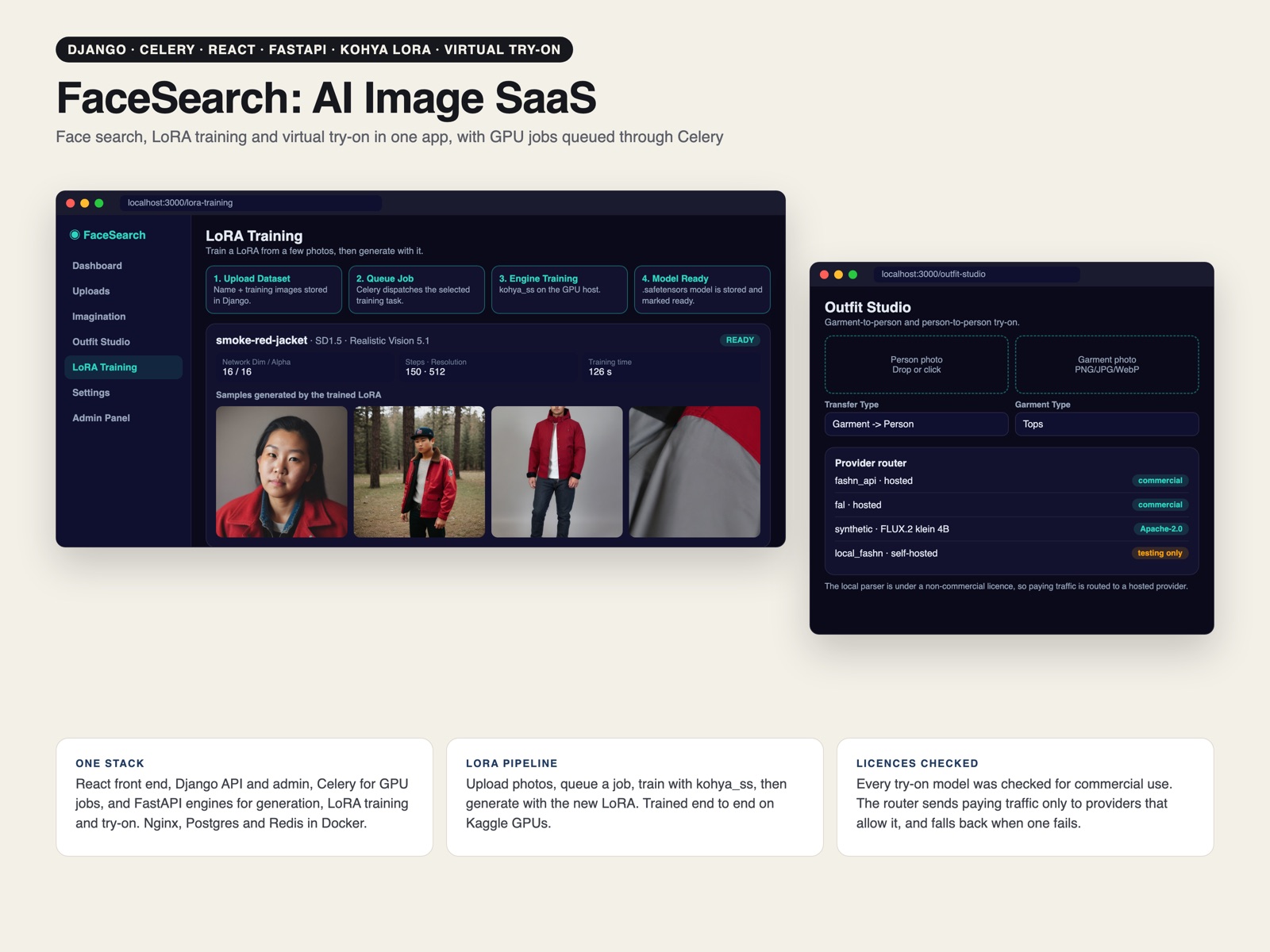
Face search, generation, LoRA training and try-on are all GPU work, so none of it runs inside a web request. A React front end talks to a Django API, Celery queues and tracks the jobs, and FastAPI engines do the work. Postgres, Redis and Nginx run in Docker, with a GPU profile for real workloads.
The LoRA Pipeline
Upload a dataset, queue the job, train with kohya_ss, and the model is stored and marked ready. The run shown trained on Realistic Vision 5.1 for 150 steps at 512 pixels in 126 seconds, and the four samples are its real outputs. Training ran end to end on Kaggle GPUs.
Virtual Try-On and Licences
Try-on goes through a provider router: two hosted APIs, a synthetic FLUX.2 klein 4B path under Apache-2.0, and a self-hosted model. The self-hosted one depends on a parser with a non-commercial licence, so it is for testing only and paying traffic goes to a hosted provider. If a provider fails, the router falls back and marks the job.
Building an AI image product?
Generation, fine-tuning and try-on behind a queue, with licences checked before anything reaches paying users. Baydot builds the pipeline and the product around it.
Book a Free Call