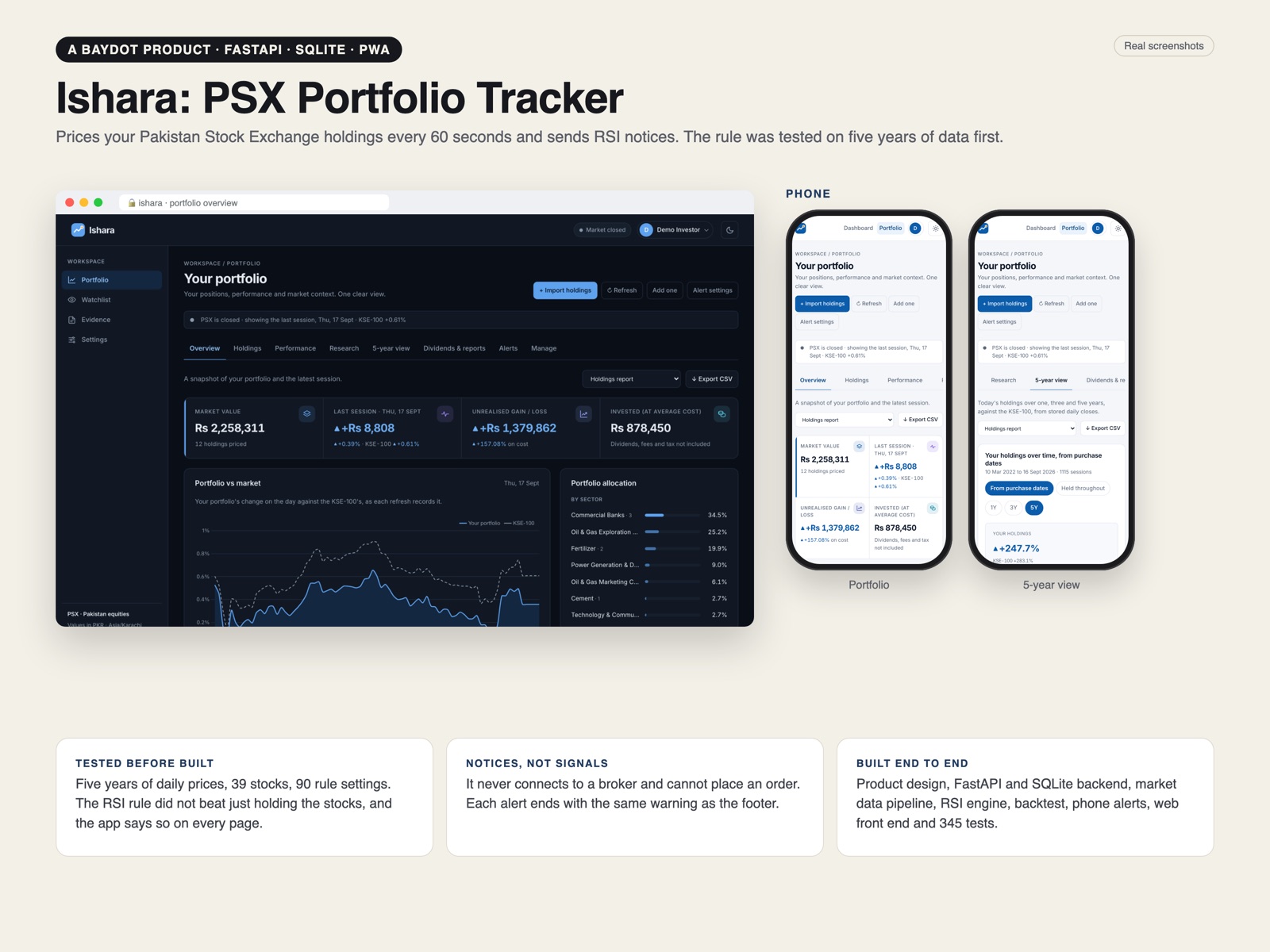
What It Does
You paste in your holdings. Ishara prices them every 60 seconds while the market is open, from the exchange's public data portal, compares each purchase with the KSE-100 from the day you bought it, and keeps five years of history, dividends and company reports in one place. It never connects to a broker and cannot place an order.
Tested Before It Was Built
The first idea was to buy when RSI goes above 70. On five years of daily prices for 39 liquid PSX stocks it lost to simply holding them on 34 of the 39, and 90 tuned settings all fell apart on a period they had not seen. Buying when RSI drops through 40 held up better, with 68% of trades making money, but it still did not beat holding.
Notices, Not Signals
So Ishara calls them notices. The evidence is a page inside the app, and the same warning sits in the footer of every page and at the end of every alert. A product that dressed this up as advice would be claiming something its own test contradicts.
Built End to End
Product design, a FastAPI and SQLite backend, the market data pipeline and price cleaning, the RSI engine, the backtest, portfolio analytics, phone alerts, the web front end, 345 automated tests and the deployment.
Building a finance product that has to be right?
Data pipelines, backtests and alerts, with the limits written down instead of hidden. Baydot builds fintech that can defend its own numbers.
Book a Free Call