What this is
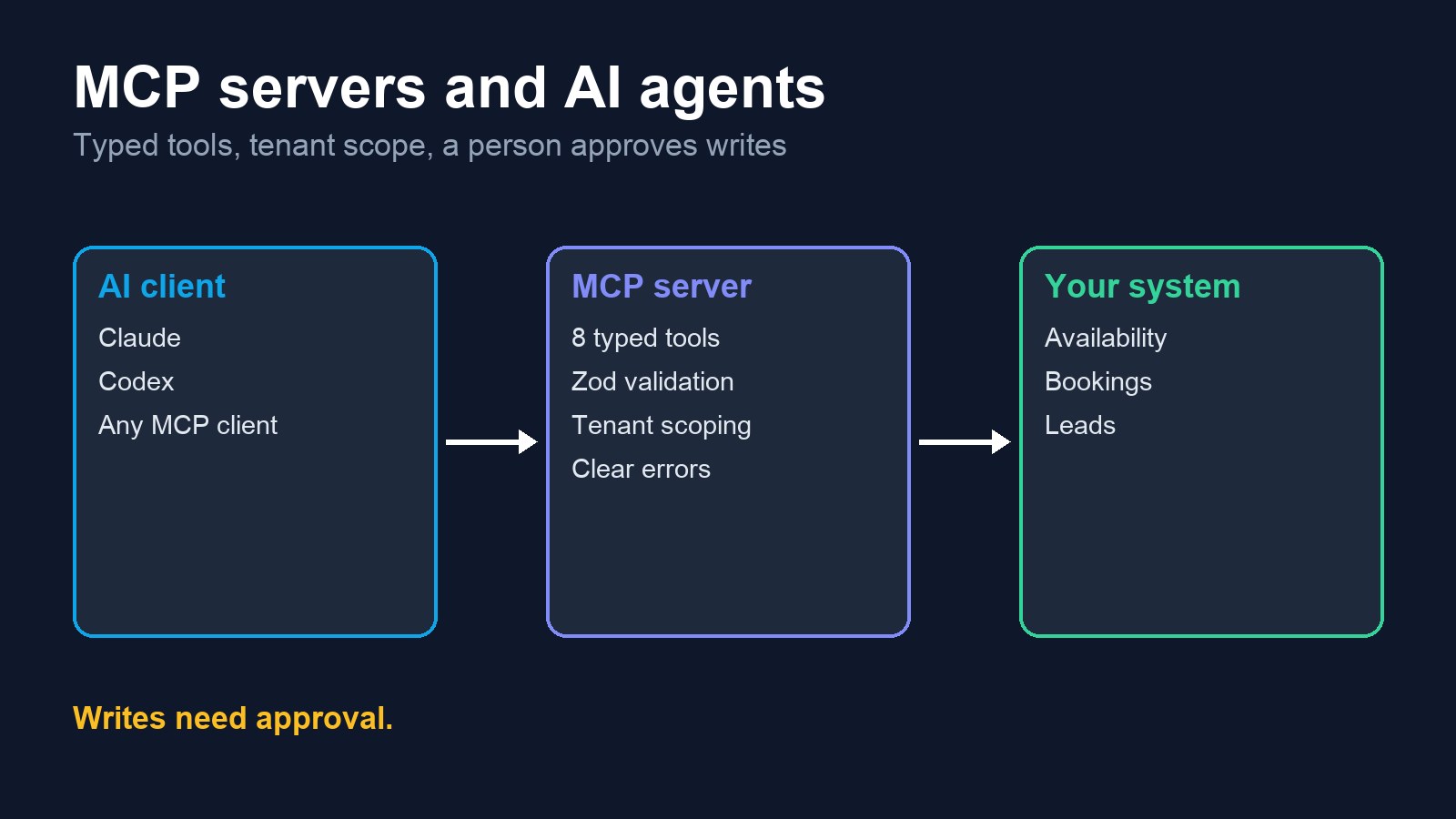
MCP (Model Context Protocol) lets an AI assistant use your software through a defined set of tools, instead of guessing from text. The work is in deciding what the model may do, checking every input, keeping each customer's data apart, and making sure a person approves anything risky.
Where each piece is real
| Work | Where | What it does |
|---|---|---|
| Custom MCP server | Job-Hunting AI (TypeScript, official MCP SDK) | Exposes an AI receptionist as tools an agent can call |
| Claude + MCP | Job search agent | Scheduled agent reads an official marketplace MCP connector |
| Codex + MCP | Same agent | Same connector on Codex, used when Claude hits a usage limit, with write tools switched off for scanning |
| Claude + Gemini + OpenAI APIs | FaceSearch SaaS | The agent layer picks a model provider by configuration |
Project 1: an MCP server for an AI receptionist
Part of Job-Hunting AI, a Baydot product. It runs over stdio, and any MCP client can connect to it.
- Eight tools: get_receptionist_config, get_services, get_business_hours, check_availability, book_appointment, list_appointments, update_appointment_status, qualify_lead.
- Typed inputs: every tool validates its input with Zod, including IDs, dates and times, before anything touches the database.
- Tenant scoping: queries are filtered by tenant, so one business's bookings stay out of another's.
- Clean failures: a tool error goes back as an MCP error the agent can read.
Project 2: one agent, two runtimes, a person in charge
A scheduled agent uses an official MCP connector to find and read job posts, then drafts a reply for review. It normally runs on Claude and moves its scan to Codex when Claude runs out of usage.
- Tools are limited per step: a scan can only read. Write tools are blocked in its configuration.
- Nothing goes out alone: sending takes a preview and then a Confirm button pressed by a person.
Project 3: the agent layer inside FaceSearch
FaceSearch is a Baydot product for face search, LoRA training and virtual try-on. Its agent layer takes a chat or voice message, works out the intent and sends it to one of 10 specialists, such as photobase, LoRA, try-on, video or billing.
- Model choice is configuration: OpenAI, Anthropic Claude, Google Gemini, OpenRouter or any OpenAI-compatible endpoint.
- Everything is on record: each run and tool call is stored per organization.
- Long jobs stay where they belong: GPU work still runs through the existing queue.
What this can do for your product
Your SaaS inside AI assistants
Problem: customers want to use your product from Claude or other assistants.
Build: an MCP server over your existing API, with per-customer access.
Booking and lead agents
Problem: an agent gives wrong times because it can't see real availability.
Build: tools for availability, booking and lead qualification.
Safe write actions
Problem: nobody trusts an agent to change real data.
Build: read-only by default, with approval before any write.
No lock-in to one model
Problem: one provider's limit or outage stops your work.
Build: switching by configuration, plus a fallback path.
How a project runs
- You share your API or database outline and the jobs an assistant should do.
- We list the tools and mark which ones read, which ones write and which need approval.
- A first read-only server, connected to the assistant you use, so you can try it on real questions.
- Write tools and access control, then a short guide for your team.
Want your product usable from AI assistants?
Tell Baydot which product you want to connect. We reply with the tools it needs and which ones should need approval.
Book a Free Call